700. The Streets of Bruma

700 (a). The Streets of Bruma

From inside the Manor House the wounded Grigerda directs the resistance against the cultist and dremoran occupation of Bruma. Every warrior wishes to lead on the battlefield, to motivate others that follow by their example of commitment and dedication, but alas for Grigerda this is not to be her fate. Sending others into the streets to fight may go against her every sentiment, but Bruma needs her not to lead, but to point the way.

The truth is however that all our acts of resistance in Bruma may not be enough to save this town from the cruel clutches of Coldharbour. With the Shadowed Path cultists roaming the streets, dremora appearing from portals all-over, and the Black Dagger bandits waiting in their holes to strike like a pack of starving skeevers, Bruma’s doom seems to be inevitable.

But what separates men and mer from daedra is that we are unable to sit back and passively accept fate. We are stubborn and fight to our last breath, because unlike the daedra our last breath is our final breath. And besides, how do you really know if it is inevitable, if you do not resist the apparent inevitable. Maybe every time we stand and strike out against our oppressors we are just tossing another stone into the sea, creating but the smallest ripple of hope. Yet maybe with enough ripples we may eventually build a tide that will wash clean the streets of Bruma. Maybe.

S.K

699. The five tasks of Hjorik

699 (a). The five tasks of Hjorik

In the occupied town of Bruma the Nord militia gallantly hold back the cultists and Dremora from the chapel doors whilst the healer Hjorik and his assistants treat the wounded and dying. One need only look about this chapel to realise that survivors of wars aren’t the strongest, nor the smartest; they are simply the luckiest.

Unfortunately Hjorik is fast running out of supplies and will gratefully accept any assistance from passing mercenaries and banners of any colour. He asks that you search the town for lost survivors, fresh water from the well, and discarded clothing with which to fashion bandages. He requests that you recharge his restoration scrolls at an ancient stone circle, gather mushrooms with healing properties from the bandit occupied Capstone Cave, and close a Dremora portal before the monsters can gather in number. Alas that it all feels like bandaging the wounds of a dying man.

Perhaps it is true that you can only see Aetherius when the sky is darkest however, for there seems no shortage of volunteers arriving to offer their aid to the survivors of Bruma. When our story is done the things we do for ourselves will rot with our carcases; it the things we do for others that paints our souls.

S.K

698. The occupations of Bruma

698 (a). The occupations of Bruma

Bruma is a city under occupation. When the Planemeld first struck, Bruma was attacked by both Dremora and Shadowed Path cultists. A Dark Anchor was swiftly built and opened above the city in an attempt to stream Daedric reinforcements into the north of Cyrodiil. It is even believed by some that they planed to draw the city itself into Coldharbour. But surely that would have been a strategic mistake, for when you have an agent in play on the Tribute board, why remove it on your own turn?

Yet in some peoples eyes Bruma has always been occupied territory, a Nordic city within the Heartland borders. But it’s not just a Nibenese city become occupied by Nord migration or conquest. It’s architecture is Nord, it’s leaders are Nord, it’s militia is Nord, and it’s icons are Nord. And it is an occupation that seems to have been acceptable to both Imperial politicians and people alike, for who else would want to live in the cold, inhospitable climes of the Jerall Mountains, but Nords.

It is clear however that the Dremora and cultists believed that the Nord city would get little support from the rest of the region, and it turns out they were right. The few survivors who have barricaded themselves within the chapel and manor house sent out pleas to the alliances for aid, but none came. Now they must rely upon wandering mercenaries and small bands of Alliance soldiers for aid, and this has meant that they now suffer another occupation, by the Banners themselves who fight blade and spell over a flagpole.

698 (j). The occupations of Bruma

S.K

697. Twilight in Toadstool Hollow

697 (a). Twilight in Toadstool Hollow

Whilst training to become a legionnaire our barracks was visited by a priest of Arkay. He spoke to us long and piously about the difference between light and darkness, good and evil. His message was that it isn’t just enough to take a stand against the darkness, we have stand apart from it too.

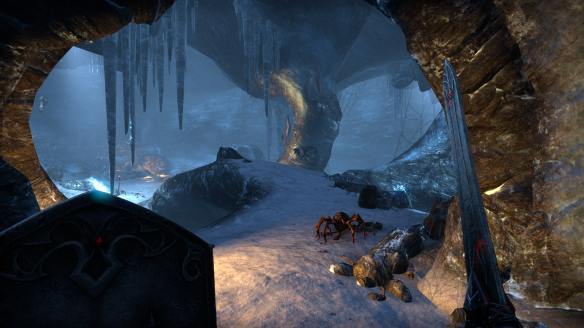
Toadstool Hollow seems a strange name for such a cold and icy cave, but then this is a strange and unaccountable place. For hidden beneath the frozen caverns infested by spiders and bats, there lies a long forgotten crypt. It’s residents, whether by necromantic means or in reaction to the anguish and turmoil in the lands above, have risen from their tombs and walk once more. I would be content to let them roam their catacombs until their bones crumble to dust, only recently some have begun to find their way above ground.

But I was also to discover a journal whilst in the crypts that suggested that some foolish residents of the near-by occupied town of Bruma, seek to reanimate more of these long-dead soldiers to rise again in defence of their land. Some might consider the undead to be but neutral tools, marionettes obeying their puppeteers strings. But it is the act of raising a corpse, be they soulless skeletons, or soulful spirits, that is at the very least, morally questionable.

No matter the adversity we face, the Priest of Arkay taught that we cannot make the mistake of fighting evil with evil. But then ask yourself, is it better to die virtuously, or to survive immorally? The lonely priests who gives up all for their calling hold their piety aloft like a torch. But for the everyday man and woman with family and friends, questions of morality can only ever be answered in twilight.

S.K

696. What lies beneath

Northern Cyrodiil is littered with ancient Ayleid ruins that were built into the foothills of it’s mountain ranges. Most are now blocked and inaccessible to the modern explorer, and some believe this is for the good; that the evils waged by the heartland elves is a history best buried. Others of course, like the scholars and archaeologists attempting to break into these lost settlements, disagree, arguing that only by looking at what lies beneath our feet, can we learn not to repeat.

So what can we learn from the perceived evils of the Ayleids? Their eventually downfall seems to have began with the rise in the influence of the Daedric cults, especially amongst their kings and aristocrats. Indeed, their domination and enslavement of the Nedic people for generations was enabled by their deals with the Princes, with entire armies of Daedra helping them to conquer and subjugate other cultures.

But it also led to a fierce civil war between the Aedra and Daedra-worshipping Ayleids of Cyrodiil, and even wars amongst themselves; it was in the company of Sees-All-Colors that I witnessed first-hand the conflict between the city states of Abagarlas and Delodiil. And eventually when the Nedic peoples rose up during the Alessian Slave Rebellion, many rebel Aedra-worshipping Mer joined forces with Alessia to help her take the White-Gold Tower, thus founding the Alessian Empire, and the resulting Ayleid diaspora.

How familiar this history to the downfall of our own Imperial Empire, which arguably began when Emperor Leovic legalized Daedra worship. Perhaps the Longhouse Emperors should have been looking more closely at what lay beneath their feet.

S.K