697. Twilight in Toadstool Hollow

697 (a). Twilight in Toadstool Hollow

Whilst training to become a legionnaire our barracks was visited by a priest of Arkay. He spoke to us long and piously about the difference between light and darkness, good and evil. His message was that it isn’t just enough to take a stand against the darkness, we have stand apart from it too.

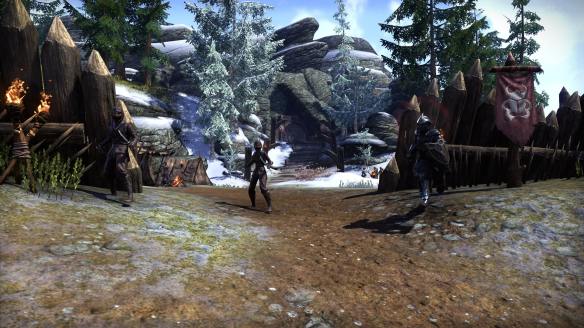
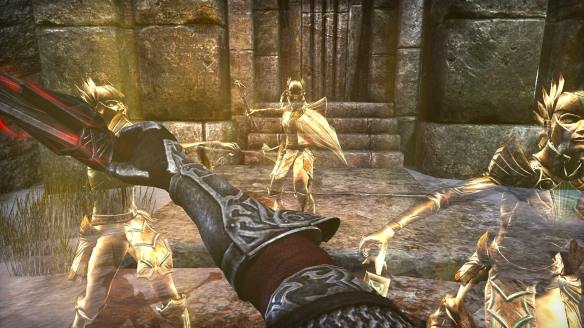
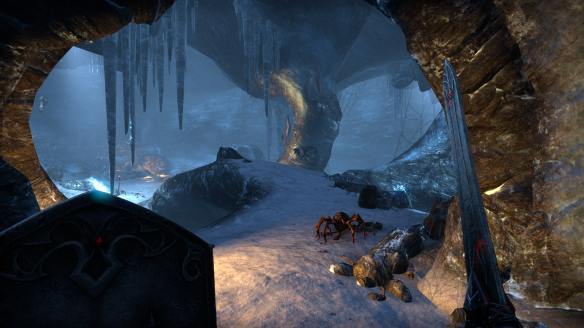
Toadstool Hollow seems a strange name for such a cold and icy cave, but then this is a strange and unaccountable place. For hidden beneath the frozen caverns infested by spiders and bats, there lies a long forgotten crypt. It’s residents, whether by necromantic means or in reaction to the anguish and turmoil in the lands above, have risen from their tombs and walk once more. I would be content to let them roam their catacombs until their bones crumble to dust, only recently some have begun to find their way above ground.

But I was also to discover a journal whilst in the crypts that suggested that some foolish residents of the near-by occupied town of Bruma, seek to reanimate more of these long-dead soldiers to rise again in defence of their land. Some might consider the undead to be but neutral tools, marionettes obeying their puppeteers strings. But it is the act of raising a corpse, be they soulless skeletons, or soulful spirits, that is at the very least, morally questionable.

No matter the adversity we face, the Priest of Arkay taught that we cannot make the mistake of fighting evil with evil. But then ask yourself, is it better to die virtuously, or to survive immorally? The lonely priests who gives up all for their calling hold their piety aloft like a torch. But for the everyday man and woman with family and friends, questions of morality can only ever be answered in twilight.

S.K

696. What lies beneath

Northern Cyrodiil is littered with ancient Ayleid ruins that were built into the foothills of it’s mountain ranges. Most are now blocked and inaccessible to the modern explorer, and some believe this is for the good; that the evils waged by the heartland elves is a history best buried. Others of course, like the scholars and archaeologists attempting to break into these lost settlements, disagree, arguing that only by looking at what lies beneath our feet, can we learn not to repeat.

So what can we learn from the perceived evils of the Ayleids? Their eventually downfall seems to have began with the rise in the influence of the Daedric cults, especially amongst their kings and aristocrats. Indeed, their domination and enslavement of the Nedic people for generations was enabled by their deals with the Princes, with entire armies of Daedra helping them to conquer and subjugate other cultures.

But it also led to a fierce civil war between the Aedra and Daedra-worshipping Ayleids of Cyrodiil, and even wars amongst themselves; it was in the company of Sees-All-Colors that I witnessed first-hand the conflict between the city states of Abagarlas and Delodiil. And eventually when the Nedic peoples rose up during the Alessian Slave Rebellion, many rebel Aedra-worshipping Mer joined forces with Alessia to help her take the White-Gold Tower, thus founding the Alessian Empire, and the resulting Ayleid diaspora.

How familiar this history to the downfall of our own Imperial Empire, which arguably began when Emperor Leovic legalized Daedra worship. Perhaps the Longhouse Emperors should have been looking more closely at what lay beneath their feet.

S.K

695. Tangles and knots

695 (a). Tangles and knots

The misnomer “Ruby Red” was given to this cave north of Chalman Keep in order to fraudulently entice people to invest into a mine in which no gems were ever actually found. It is no surprise therefore to discover that it has since been taken over by the Black Daggers bandits.

I have been encountering the Black Dagger’s illicit activities all over Cyrodiil, from Hackdirt down to the Green Lake, from Breakneck up to the Ruby Red. Their operation spans the Heartlands like a spiders web. As I traversed the region I began pulling apart each strand I found, even managing to kill their leader who I accidentally discovered in the supposedly abandoned Breakneck cave in the south, and fully expected their web to collapse. After all each strand of a spiders web is connected so a vibration anywhere should be felt everywhere.

695 (g). Tangles and knots

But alas it was not so, for according to a note I discovered the bandits here at Ruby Red are awaiting upon orders from their posthumous leader to attack the nearby town of Bruma. Building a web in darkness it seems only end in tangles and knots, and one might argue that this bandit gang is only still a threat in the north because of such failures.

695 (j). Tangles and knots

S.K

694. Perceptions of Pelinal

694 (a). Perceptions of Pelinal

In the foothills of the Jerall Mountains, west of Kingscrest Keep, three ghostly figures can be found guarding the sealed entrance to the Ayleid ruins of Sedor. These ruins play an important part in human history, for it was here during the Alessian Slave Rebellion that the wandering King, Pelinal Whitestrake, won back the freedom of the ‘Thousand-Strong of Sedor’, a human tribe enslaved and held captive by the ancient Mer who inhabited here.

To humans, especially Cyrods, Whitestrake is a hero and a saint, a Divine Crusader who helped free Cyrodiil from Mer oppression. To the Ayleid’s he was a villain, a bloodthirsty warlord whose sole aspiration was the annihilation of their culture. I wonder how modern Mer view Whitestrake now? I am certain none would call him a hero, but could they acknowledge his achievements in context of Tamriel’s history? Probably not, for our histories are forever dyed by the colour of our suffering.

694 (d). Perceptions of Pelinal

It is a lie that history is always written by the victors. When two cultures clash both sides record the event from their own biased perspectives. Whether they be the winners, losers, or onlookers, we all see the same acts from different angles. Our libraries are filled with our perception of history, whist libraries in foreign lands are filled with their own, often conflicting with our version of the same events.

The wise will say that we must learn from history so as to not repeat it, but we can never learn from a history that teaches us that we are forever the oppressed and never the oppressor. Every single group of people in Tamriel have been both the oppressor and the oppressed at some point in time. Every single nation and religion has persecuted other people for being different or not accepting their god, and yet we look back in our own history books and record only where we have been challenged, hurt, betrayed, and beaten. And It goes on still, because the only history we have not learnt from is that of our enemies.

694 (g). Perceptions of Pelinal

S.K

693. To light a candle?

693 (a). To light a candle

Is it It better to live with fear, hope and wonder, or to know what is to come? For most people the unseen future is a frightening prospect, like walking into the darkest of nights without a torch. Yet surely stepping into the light can be just as daunting as the dark. For if we knew all the consequences of our own actions would we still have the courage to fulfil our destiny?

The Temple of the Ancestor Moths in the White Fall Valley of north-eastern Cyrodiil, is home to the Cult of the Ancestor Moth, a priesthood dedicated to the practice of divining the Elder Scrolls. The Scrolls are said to archive all of Tamriel’s history and future simultaneously. The process however extracts a heavy price upon the augurs, rendering them blind of both sight and clarity; they do say that to light a candle is to cast a shadow. Our eyes however can only see what our minds can comprehend, so surely these augurs are but slaves to their perceptions, their minds denying knowledge in order to rationalize their faith and bias. They also tell us the information they reveal is never absolute, and that our destiny is our own to craft; only once a foretold event is carried out does it become fixed. So I have to ask, what is the point to their practice?

Many of these Elder Scrolls were stored within the Imperial Library at the White-Gold Tower, but when the Dark anchors fell upon the city and the capital was lost, the Cult moved them, hiding many around the grounds of the Temple of the Ancestor Moths. Eventually however Banner’s soldiers discovered the scrolls and stole them, building their own temples across Cyrodiil to house them close to the battlefield, thus bestowing the Scrolls’ supposed blessings upon their troops. Any experienced General will tell you that it is not numbers or strength that bring the victories in war, it is having stronger morale then your adversaries.

Moth Priest Crassius Viria who leads what is left of the Cult of the Ancestor Moth has sent emissaries to reason with the alliance leaders, although none have yet returned. Ironically if the Scrolls were to be returned then perhaps the augurs might divine the path of this seemingly endless war. Such potential knowledge is perhaps more powerful than any sword or spell. But then what would sap an army’s morale more, fear of the darkness, or fear of the light?

S.K