342. Morwha’s Bounty


342 (f). Morwha_s Bounty

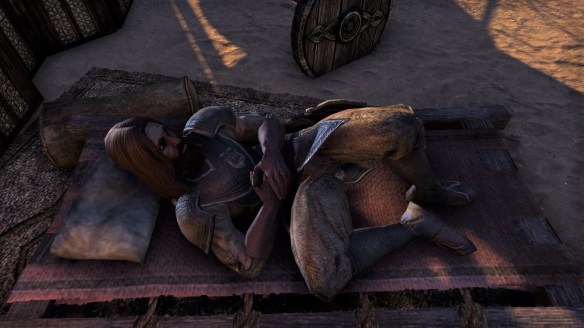
I find the Ash’abah camp south of the road to Bergama.  Forevermore the pariahs of the sands, and yet the Kingdom of the deserts only defence against the undead armies of the Withered Hand.

The Redguard’s of the Alik’r consider it a sacrilege to take up arms against their honoured ancestors, swearing a curse to Tu’whacca upon the families of any who desecrate them; even when their ancestors are being risen for nefarious purpose.  The Ash’abah have sacrificed their place amongst their own people to protect Hammerfell from the undead threat, and yet the people hate them for it.

Often when outcasts are exiled for long enough, they will begin to thrive upon being hated, their infamy becomes their very nature, and they forget that all that stands between themselves and self-destruction is their honour.  Thankfully for the people of Hammerfell, the Ash’abah of Morwha’s Bounty appear to have retained their honour.

Recently however their water supply has been poisoned, leaving their chief Marimah, and many of their tribe upon their deathbeds.

It would be easy to attribute this attack to the Withered Hand, but the sad truth is, it could just as easily have been perpetrated by the very people the Ash’abah have sacrificed so much to protect.

S.K

341. The irony of vengeance

Beneath the Southern walls of Sentinel, Samsi af-Bazra can only watch as the Badwater Mine collapses down upon her partner and her supplies.  Alas that her partner was not to make it out alive, but his ghost lingers to tell a very different story of his fate then that told by the Redguard woman.

The spirit believes that he can only find rest in the afterlife when he has had his revenge upon the one he claims betrayed him.

341 (g). The irony of vengeance

That is the irony of vengeance, that it makes the vengeful forever dependent upon those who have wronged them, their release from their self-torment only coming when their adversary suffers the same fate, or worse.

S.K

340. A Dark Fissure in the sands

I witness a Dark Fissure form in the desert wastes south of the harbour city of Sentinel, from which Daedra poured forth onto the baking sands.  As to what mischief these servants of Oblivion had planned I could not say, for I dared not risk letting them roam free.

This is not the first such rift I have seen open beyond the Dark Anchors.  Has Molag Bal’s Planemeld weakened the veil between our realms so much that Daedra will soon be able to come and go as they please?

S.K

339. The Bandits of Santaki Delve

Dwemer machines are not the only dangers lurking in the sombre halls of the Santaki Delve.  A gang of bandits led by an impressively armoured Dark Elf, Tarrent Herano, appear to be searching the industrial ruins for something?

Perhaps it is this mysterious ‘Guardian’s Eye’ artefact I keep finding reference to in loose journal pages scattered throughout the delve.  If it is then they are looking in the wrong place, for according to the last entry the artefact was moved long ago to another site called Aldunz.

S.K

338. The many faces of Santaki Delve

338 (a). The many faces of Santaki Delve

The mysterious sudden disappearance of the Dwemer race centuries ago has left many open questions to which scholars and archaeologists have been unable to answer.  One such question that struck me whilst searching the bleak halls of the Santaki Delve is why the Dwemer here incorporated so many facial images into their architecture, large machines, and even the Spheres and Centurions that patrol their subterranean fortresses to this very day.

Could it be that theirs was a dystopian state?  A totalitarian or authoritarian society that felt the need for their citizens to feel as if they were being watched through every wall, observed by every machine, and minded by every Automaton?

Or perhaps the almost uniform images were that of the Dwarven ruler of the time.  A cult of personality, the omniscient monarch’s image emblazoned in every structure.  An ever-present symbol to the citizens of an ever-expanding empire that they are all part of a collective, and subject to the legitimate rule of one leader whom they will almost certainly never meet or see.

Or maybe it was the people’s own insecurities that led to the forging of such images.  For almost every society defines people by the jobs they do, and more and more of these jobs were being taken up by the machines and automatons.  Perhaps these were but the reflections of a people struggling to hold onto their identities.

I fear we may never discover the answers to these and the many more important questions about the Dwemer’s sudden disappearance; but then again, I never would have thought I would get to meet the last King of the Ayleids on the ancient battlefields of Glenumbra Moors either.

S.K