455. Preinrha and the prince

Screenshot_20191229_205312

No mater how many dark anchors we repel, or how many daedra we send back to Oblivion with our blades and spells, we can never lower our shields and wards, because the guileful agents of Molag Bal are here amongst us, patiently watching and waiting for opportunities to undermine us. For the longer the Three Banners war rages on, the more vulnerable our homelands become.

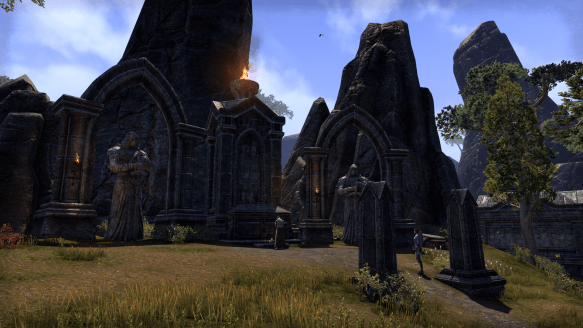
Inside the church of Arkay at Pelin Cemetary, the deception and corruptions of one such agent are uncovered. But for a vigilant few, Preinrha the harvester, a daedric servant of the God of Schemes, would have had an undead army led by a noble son of Bangkorai with which to wreck havoc.

With Arkay’s blessing it is time to lay the prince to rest once again.

S.K

454. Divine serendipity?

Screenshot_20191229_201816Screenshot_20191229_201916

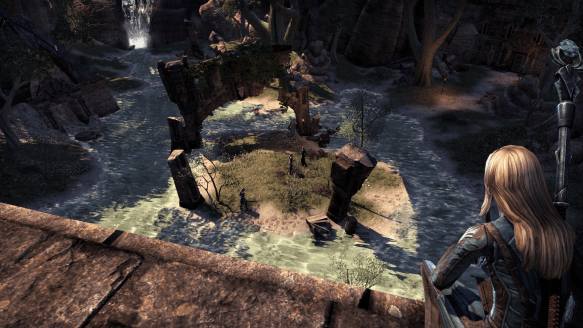
At the Pelin Graveyard where the dead are rising from their plots, I find a solitary priest of Arkay praying most intently. I wonder, is he praying for an end to this misery, or for the strength to endure it? Either which, whilst I am pretty sure it is serendipity that has led me here and not some Divine shepherding, it would be a blister upon my conscience if I did not offer the priest what aid I can.

It does make one think however, all those years ago when the Grey Host were about to break the gates of the Bangkorai Garrison and Saint Pelin, then but a lowly church beadle, leapt from the battlements of the garrison into the slaughterous horde of bat-men below. His sacrifice gave the garrison’s soldiers time to reinforce their positions, and eventually lead to the defeat of the insidious host of Verkarth.

Could it have been only serendipity that lead this pious man to the battlements and inspired his act of martyrdom, wherefore even the most devout would have been justified in taking flight at the darkness engulfing the light.

I do not believe in Divine Intervention, rather I believe in people intervening divinely. The priest may argue that is all but semantics, but to a man searching for his soul, it may prove a distinction of cardinal merit.

S.K

453. The resurrection of Adrien Guimard

Screenshot_20191229_195440

At the Pelin Graveyard, one of the largest cemeteries in all of High Rock, the dead are rising from their graves. One would have thought Bretons would have learnt to burn their dead by now, or at least stopped burying them with their weapons. But then something is very different about this necromantic attack from the ones I’ve witnessed before.

For a start, where are the necromancers? The Reachmen, for the most part, have been driven back into their mountains to the North, and by all reports the Seventh Legion are still consolidating their newly won position at the Bangkorai Garrison. And besides, to raise so many, so quickly, in such a vast cemetery as Perlin’s would require an army of necromancers; yet I have seen none.

And then there is Prince Adrien. The son of King Eamond who fell beside his father fighting the Reachmen at Northglen. He has not just risen, he has been resurrected, fully sentient and hearty, almost as if he had never been dead.
Screenshot_20191229_195949

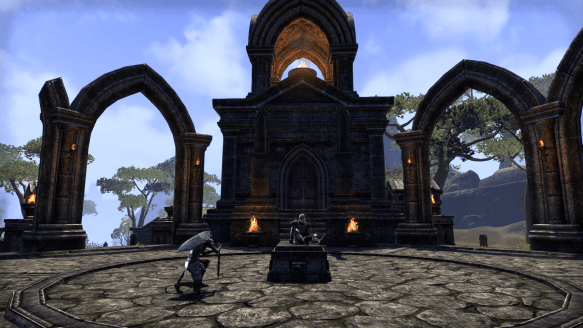
A mysterious voice in the royal crypts makes claim that Arkay himself is responsible, blessing the Prince to rise again to lead an army of the Undead to avenge his bloodline. Remembering what I was taught of the Divines as a child, and my experiences with the Arkay priest’s Marnest Barclay and Alvaren Garoutte in Rivenspire, it is utterly inconceivable that the mortals God, who champions the natural journey from birth to death would countenance such an act. And yet, and yet both Prince Adrien and his guardian Dame Valyrie Spenard are swift to accept it as true.

I’m beginning to learn that people are willing to believe in the most outlandish notions, despite them often flying in the face of all rationale like an agitated Cliff Strider, because they are desperate to believe in something, anything. The biggest fear we have is just not knowing. It is how so many cults flourish across Tamriel, because they offer people an explanation for their miseries that neither the priests of the Divines, nor society cannot. When you are an ugly man you do not worship the Divines for their beauty, you blame them.

S.K
452. The parley at Nchu Duabthar

Screenshot_20191229_192337

Threats, barbs, and taunts, an impetuous act, a deception, a trap by one, an ambush by the other, and daedra, lots and lots of daedra. Its safe to say that the parley between Queen Arzhela of Evermore and the Imperial Magus-General Septima Tharn went about as well as could be expected.

Queen Arzhela should perhaps have known that Imperials do not offer parley on the back foot, it is always but a tactic to strengthen an advantage. As courageous and resolute as Azhela has proven, the arrival of King Emeric from Wayrest will add some much needed seasoning and acuity to the court of Evermore, especially if they are to survive the incursion of the Seventh Legion.

S.K

451. Musings on the doorstep of Nchu Duabthar

Screenshot_20191229_191456

What little knowledge we have of the Dwemer has been traditionally harvested from either the historical records of their battles with other races, or the excavations of the ‘forsaken’ cities they left behind. Few accounts can be assumed to be reliable or accurate however, as both are heavily tainted by the distorted perceptions of their interpreters.

It is no surprise that by their enemies narrative the Dwemer were portrayed as a terrible people; cruel, callous, and unsympathetic to all other races. What is perhaps surprising is that this portrayal has endured and is so readily accepted even today. And the archaeologists that now delve into the ruins of the Dwemer cities that are found across Morrowind, Hammerfell, High Rock and Skyrim, do so prejudiced by these historically partisan reports. But perhaps more importantly, the industrious society of the Dwemer is being judged by a people infatuated with all things magicka. It is a fact that many of the most influential scholars in Tamriel are also either prominent members of the Mages Guild, or claim to share strong links with the esoteric Psijic Order.

Screenshot_20191229_191726

And yet we appear no closer then we were a millennium ago to discovering the fate of the Dwemer, understanding their achievements, or replicating their technology. Some believe that our dependence upon magicka has stifled our natural capability for invention and innovation. That the infinite possibilities of mortal ingenuity has being sacrificed for the sake of a finite dogma, and the vainglory of the few.

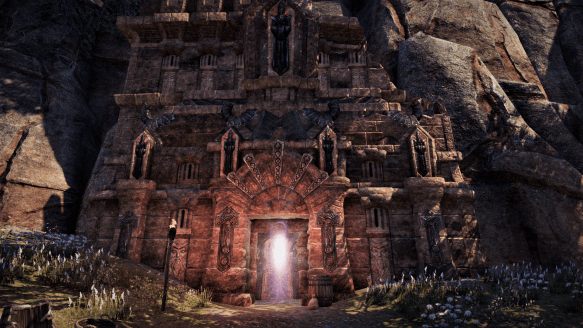
Here we stand on the very doorstep of the Dwarven city of Nchu Duabthar in central Bangkorai, and yet so far none have been able to break open the city’s seal. Through the doors we can clearly hear the clank of pistons, grind of gears, and hiss of steam, only able to imagine the hustle and bustle of the automatons going about their daily routines, utterly oblivious to the outside world. We can feel the heat of a dynamic, working city through the walls, and we can watch the ground water gently vibrate with the each heartbeat of the hidden metropolis beneath.

What secrets lie behind these doors, what explanations, observations, interpretations and elucidations awaits? Perhaps one day it will here where we might discover something unequivocal and untaintable. Is Nchu Duabthar an answer, or just another question?

S.K