381. Totems of corrupt intent

5

It is a question so compelling it drives me on through the horror that surrounds me…

The necromancers of the Withered Hand Cult have overrun the port town of Tava’s Blessing in Northern Alik’r, killing almost every living thing, be it man, mer or beast.  Almost all, for the heir to the Redguard throne has somehow managed to survive the massacre, holding off the cultists in a warehouse with a small group of retainers.

Hammerfell is a land that  does not look kindly upon magicka-users, considering them at best unnatural. Necromancers they consider to be downright immoral, believing that they desecrate the mortal’s natural journey from life to death to the Far Shores. Even mages and sorcerers look unkindly upon the act of manipulating souls of mortals to reanimate their corpses.

Yet even the greatest of their orders are not foolish enough to underestimate the undaunted will of the necromancer.  For every attempt to raise the dead is thwart with dangers, not least the risk of a failed binding, or a corpse too far separated from life that it results in a feral undead who is just as likely to turn on its reanimator as obey them. The scouring sands of the Alik’r however preserves its corpses for centuries, allowing the skilled necromancer to successfully harvest the souls of warriors long since passed.

The first thing I noticed when I entered Tava’s Blessing was the smell, it struck hard like a punch in the nose, and it took me a while to overcome the involuntary gagging.  I am used to death, and I am used to corpses, yet the stench of rotten meat and burnt skin hangs thick here. It sits upon the air like a heavy blanket, suffocating my every breath.

There is an almost deafening buzz of tiny wings as thick clouds of insects creep across the town like black ghosts, gorging upon the bloated bodies, entrails, and coagulating blood left to fester in the streets.  Uncertain squawks and bickering of carrion birds can be heard from the near-by rooftops, unsure whether it is safe for them to swoop and scavenge, wary of the cultists who wander amidst the carnage chanting and hissing in what seems a gibberish language.

Dressed all in drab leathers, stained and caked with dried, blackened blood; bonelords and brutes, rogues and mystics, sorcerers and defilers, the host of the Withered Hand, gather in small groups, pilling corpses around ghastly totems, preparing ritual for corrupt intent.  

And all the while I am driven to fight my way through this horror that surrounds me by that one compelling question….. 

Why have the necromancers not raised the dead of Tava’s Blessing?

S.K

380. Tava’s Blessing

8

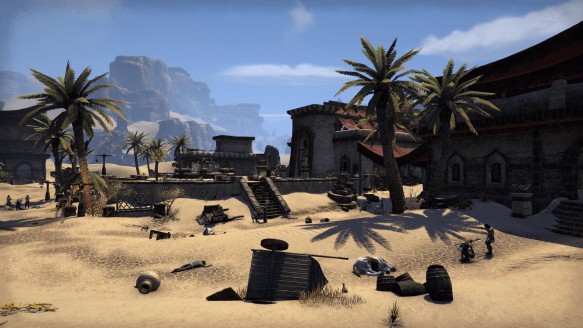
Tava’s Blessing is a port city on the northern coast of the Alik’r desert, and the home of King Fahara’jad’s naval shipyards where, taking advantage of the natural deep waters of the Boralis coastline, new ships are being constructed for the Covenant navy. Despite being a desert people, the Redguard have a rich maritime tradition dating back to the first era when the huge Yokudan armada first crossed the Eltheric Ocean to claim their new land of Hammerfell.


Maintaining a strong navy is essential for it enables a country to carry war to the enemy so that it is never fought upon their own lands; and also as the Breton adage goes, ‘He who commands the seas, commands trade. He who commands trade, commands wealth. He who commands wealth, commands the seas.’

6

But that was all before the Withered Hand arrived, now this once industrious, bustling port is quiet, deathly quiet. 


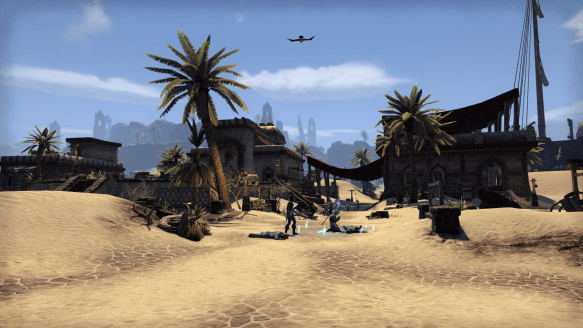
The fanatic cultists have seemingly left none in the city alive. The briny air of the sea is now stifled with the overwhelming stench of rotting corpse and drying blood, and carrion birds have usurped gull and heron from the skies. The only movement now in the streets of Tava’s Blessing are small groups of drab leather-clad figures preparing for their foul rituals by arranging dead bodies around totems and sinister circles drawn in the sands.

412

And now I am told by the watching Ash’abah that trapped somewhere within this nightmare is Prince Azah, the son of the King.

S.K

379. A question of honour

It appears the only way I am to be paid for this misadventure atop Sep’s Spine is to enable the escape of the swindler Ashtad.  To achieve this I must challenge Bloody Wildur, the leader of the Ungodly Bandits, to a duel, which I am told according to their own ‘unwritten rules’, he will be honour-bound to accept. Like a Breton knight it would seem these bandits love the epithet of honour more than they fear death, although perhaps they are more akin to the nobility of Stormhaven, in that they confuse their honour with pride.

As a former legionnaire I wore my honour like armour, believing it to be a man’s greatest quality next to courage; yet what honour I had was stripped from me by the ritual bodkin of an elf necromancer.  But what value is there to be found in a bandit’s honour who lives his life without morality or decency? And yet a bandit might ask what value is there in a soldier’s honour, if that soldier’s every deed is subordinate to another’s integrity?  

And a peasant might ask, what use is honour at all in such an unjust land as this?

S.K

378. The Ungodly Daughter

Screenshot_20180725_170417

Screenshot_20180725_171423

They say that a swindler will never lack for a dupe in a den of thieves; at least that is what Ashtad was hoping when he came to the bandit camp at Sep’s Spine.  He never accounted for the pragmatic intuition of the chief’s daughter Sarveeyah at-Wildur however, nor her own duplicitous intentions, which drags both him and me into a plateau full of troubles.

S.K

377. Sep’s Spine

Screenshot_20180725_165717

Screenshot_20180725_165850

In the lawless wastes of the Alik’r Desert, bandit gangs are rarely, if ever, caught or brought to justice. Not because it is not known that they are bandits, or that people do not witness the crimes that they commit, but because there is no civic guard or soldiery to enforce law and order in these anarchic lands, and the bandits themselves are often seen by the desert’s natives as liberators and protectors from corrupt officials and wandering outlaws. They are often viewed as vigilante entrepreneurs and opportunists, heroes to the downtrodden and forgotten of the shifting sands. But mostly, it is because everyone knows you cannot accuse them of banditry and live.

Thus this band of brigands that calls themselves the Ungodly, feel secure in their camp high atop the plateaus of Sep’s Spine, operating without fear of justice or reprisal.

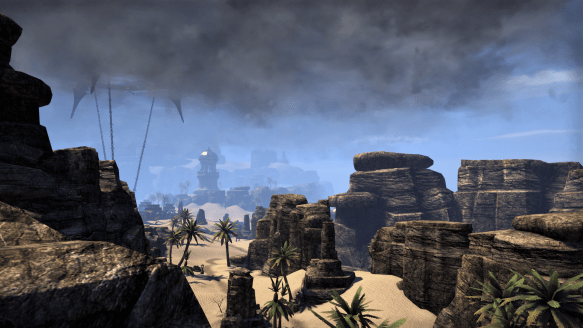
The plateau itself, named perhaps because the surrounding rock ridges resemble the coiled skeleton of a snake, offers the bandits remarkable views of the docks at Tava’s blessing, the school at Leki’s Blade, the Aswala Stables, and all the important roads and wayshrines of the Northern Alik’r.

It would seem the Ungodly hold an almost impregnable position in the desert badlands, yet the story of the Yokudan god Sep teaches us that it may well be the insatiable greed of the bandits themselves that will lead to their eventual, inevitable demise.

S.K