332. The Redguard King

332. The Redguard King

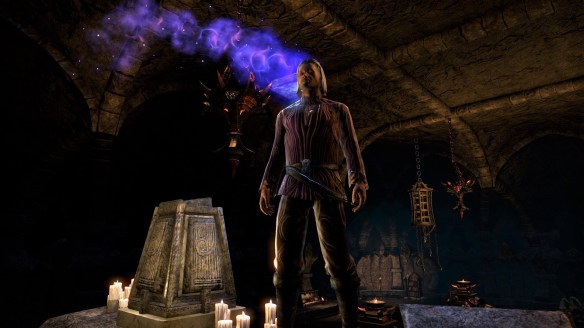
Fahara’jad, the High King of all Hammerfell, holds court at Samuruik, the Palace of Sentinel.  There were many in High Rock who felt given King Emeric’s recent displays of ‘vulnerability’, that the noble Fahara’jad might make for a better leader of the Daggerfall Covenant.  But in the short time since I arrived in Sentinel, it is already clear to me that the Redguard King faces enough instabilities in his own land that he needs to prove himself against first.

He knew of the Withered Hands undead assault upon the docks but did not act, it was an unexpected stranger who stopped the threat of the necromancers.  Fahara’jad suspects that the attack on the docks was but a rook, and that the Withered Hand have something far worse planed.

Many years ago, the arch-necromancer Suturah led an undead army against the Redguard people and but for the dishonoured Ash’abah, would surely have taken their capitol.  The Redguard believe it is a dishonourable sin to fight their ancestors, even those long dead and risen by foul magic, and that those who do so are forever cursed.

So Fahara’jad secretly called upon the Ash’abah for aid, but then publicly claimed it was divine intervention that saved them.  And now he tells me that the gods guided me here to save his city?!  Perhaps in doing so he is just employing the same device he used years ago to shroud his peoples’ weakness, or perhaps it is that he has told the lie so often, and for so long, that he himself now believes it true?

The Alik’r is divided by more than just the barren, inhospitable sands, it is a land cleft by the contrary ideologies of its people; the progressive Forebears, and the traditionalist Crowns.  Any sign of weakness from the court could be seized upon by either or both, making every move Fahara’jad makes a chary hop between the duneripper’s claws and the scorpion’s tail.

S.K
331. The unwelcome marketeers

331 (a). The unwelcome marketeers331 (b). The unwelcome marketeers

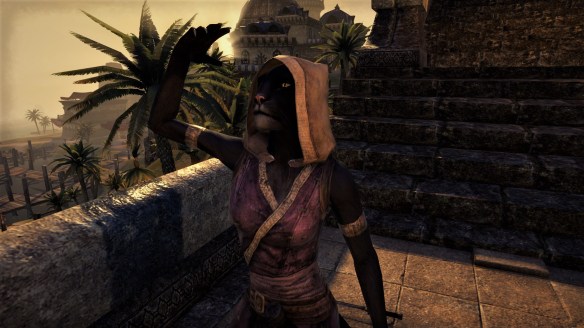
Merchants and peddlers from across Tamriel brave the harsh arid climate of the Alik’r to do trade at the great bazaar of Sentinel, which stretches across the sandy floor of the desert city from the docks to the front gate.  Brusque Orcs from the mountainous north, haughty Elves from the isles to the south, reptilian swamp-tillers of the Blackmarsh, and avaricious Khajiit from the forests of Elsweyr, all have crossed land and sea to seek fortune, curio and rare antiquities at the great market in the sands.

There is one group of travelling merchants however who are not especially welcomed by the cities authorities. The nomadic Baandari tribe have an unfortunate reputation for holding profit ahead of ethic, conscience, morality, and oftentimes local law.

Ildani, for example, was caught by the local guard attempting to smuggle skooma into the city.  Somehow, she managed to escape her binds and now seeks an accomplice to retrieve her contraband from the customs house and distribute it to her desperate clientele.  Whilst Unishi is a Baandari potion-maker staying at the Frozen Palms Tavern, whose literal interpretation of her customers’ requests she fulfils with little regard to consequence or decency.

It is difficult however to feel sympathy for the ‘victims’ of the Baandarii, for one thing all seem to have in common at this great market in the sands, is an improvident desire for quick profit and easy coin.

S.K

330. The Council of Province Generals

330 (a). The Council of Province Generals330 (b). The Council of Province Generals330 (c). The Council of Province Generals

At the Fighters Guildhall in the great desert city of Sentinel, the council of province generals sits to discuss the recent attack on the Earth Forge and the disappearance of their Guildmaster, Sees-All-Colors.

Of the former provinces of the fallen empire, only High Rock, Valenwood, Cyrodiil, Skyrim and Elsweyr are represented here.  Many brave generals have been lost to the dark anchors, to deceit and treachery, and to the fall-out from the mysterious death of the previous Guildmaster, Jofnir Iceblade.  That they have not been replaced suggests disorder and mistrust blights the guild.

The Redguard’s tell a parable of two brothers, Abazander and Mirzand.  They were always fighting, usually each other, every day and night, over anything and everything.  One night they were once again fighting in the street outside their home, this time over which loved their mother more.   So intense was their brawl that they never noticed the burglars who snuck into their home to steal their most treasured possessions and murdering their mother in cold blood when she attempted to stop them.  We need to stand united with our brothers and sisters, whether they be kith or kin, for the darkness will divide us, and takes from us what we hold most dear.

I am sent to meet with Aelif to investigate the death of Jofnir.  His final journal entry said that he last travelled to the Dwarven ruin Ragnthar, via the city of Bergama to the south.

S.K

329. Uncle Leo

329 (a). Uncle Leo

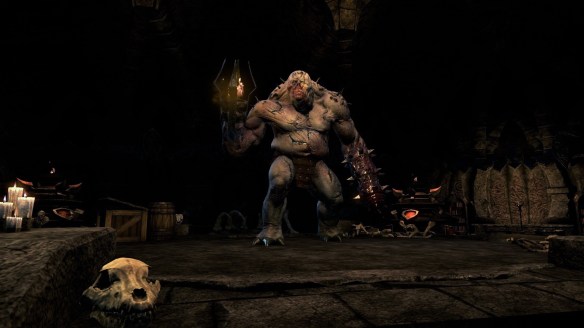
In the dark heart of the Chateau of the Ravenous Rodent, Sheogorath reveals his most prized fool.

Uncle Leo, as the prince calls him, was once a mortal man whose greed led him into a seemingly perfect bargain with the Mad God.  But for all Sheogorath’s suppositious lunacy, there is no prince in all Oblivion that understands mortal frailties more.  He waited patiently, and eventually, just as Sheogorath expected, the mortal’s heart overruled his head, and on his happiest night, the Mad God melted his flesh and remoulded him into the abomination I see before me now.

329 (i). Uncle Leo

Seemingly tired of his prize, in much the same way as a cruel child might drop a wild skeever into a box with a pet snake, I have been set against this malformed behemoth for the Mad God’s perverse entertainment.

S.K

328. The Chateau of the Ravenous Rodent

This slideshow requires JavaScript.

The main house of the Chateau of the Ravenous Rodent, is a macabre and disturbing building.  Its residents, who Sheogorath describes as his ‘family’, are clearly mind-shriven and deranged, attacking savagely without cause or logic.

These former playthings of Sheogorath, corrupted and driven into insanity, may once have been his devout followers, or, perhaps they were just everyday, rational, earnest people, whose misfortune it was to have crossed the Mad God’s path and become his sport.

Madness can be pardoned, but even in Gods, it is never an excuse for cruelty.

S.K