480. Not all constructs are made equal

Screenshot_20200501_192337

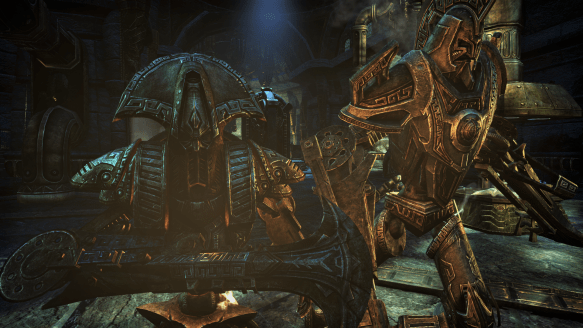
Whilst the ingenious architects and builders of these wondrous Dwemer cities are now all but folklore, their creations live on in self-sustaining autonomous societies where every construct is but a moving part of a much larger mechanism. But even in these egalitarian utopias not all are made equal. The design of Dwarven spiders, spheres and centurions has been found to be fairly universal throughout Tamriel, and for the most part the Dwarven constructs I encounter in Razak’s Wheel were made the same, only a few were made a lot bigger.

I begin to wonder about those who centuries ago subsisted amongst these constructs in their underground settlements. Living constantly with the stifling heat from the giant machines in the subterranean halls, the taste of stale, humid air, the smell of grease and burning oils, the sound of the metal spiders scuttling through the metal pipes in the walls, floors and ceilings, and the sight of the strange spheres that appear before you seemingly out of nowhere, then suddenly and violently bloom like metal flowers to stand awkwardly upright. Or even subconsciously, the constant uneasy feeling that the eyes of the centurions are watching your every move.

Surely some amongst Dwemer society must have felt a little resentment towards their own creations, whether it be for their unnaturally relentless efficiency, or because the more freedom the constructs gained, the more freedom the Dwemer themselves would have lost.

And from there perhaps one might begin to speculate as to why so many spheres and centurions were needed. Was it to protect the Dwemer people from the those outside their walls of stone, or to protect the machines from those within?

S.K

479. The Imperial Legion at Razak’s Wheel

Screenshot_20200501_185408

As her grip on Southern Bangkorai weakens more and more, it is perhaps a sign of desperation that Septima Tharn has sent such a large force into the ruins of Razak’s Wheel to chase what may be little more then myth or legend. Led by the experienced Major Cirna, other notable Imperials I encounter in the ancient city include the Spymaster Geta, the Archivist’s Poneria and Sanctius, and the seasoned Centurion Solinthia.

Screenshot_20200501_191202

Whilst the Imperial presence is indeed strong, it has need to be, for Razak’s Dwarven constructs are proving to be uncommonly aggressive and robust.

The Imperial squads I encounter in the tunnels and halls are the expected mix of scouts, legionnaires, batllemages, and the odd necromancer. But what I don’t meet in these dark and murky ruins are any daedra. I witnessed first hand at the Bangkorai Garrison the Seventh Legion’s nefarious pact with Molag Bal, where banekin and daedroth made up their final line of defence. So given the obvious importance Tharn has placed in this venture, where are they now?

Screenshot_20200501_190904

Perhaps it is that the daedra proved just too difficult to control in the tight confines of an underground city, even for the Legion’s battlemages. Maybe even this most corrupted of Legions have lost faith in their demonic allies.

Or perhaps the daedra just don’t cut the rustic mustard when it comes to battling Dwarven constructs. For much of the daedra’s power against mortals comes from the fear and dread that their outworldly and unhallowed appearance incites. Indeed most men and mer will either cower or flee when faced with the horror of these creatures of their nightmares. Yet Dwemer constructs know not the meaning of fear, anxiety, or indeed emotions of any kind. They have no imagination, so they do not dream. One might even go as far as to speculate that it might be in fact the daedra who fear the emotionless constructs of the Dwemer; for what unsettles a bully more then the bold and the dauntless?

Screenshot_20200501_200012

Moreover, could it possibly be that the Gods themselves were in such fear of what these Mer had created, or had the potential to create, that it eventually led to the Dwemer’s sudden, inexplicable disappearance from Nirn?

Perhaps I should leave such whimsical conjectures to the scholars, for I suspect that before we finally catch up with Septima Tharn, I have not seen the last of the daedra in Bangkorai.

S.K

478. Standing on the shoulders of giants

Screenshot_20200501_184840

Just off the southern desert road out of the city of Hallin’s Stand in Bangkorai, I find the burnt corpse of a Seventh Legionnaire next to the battered and broken remains of a dwarven construct. Underneath his body I recover charred notes that seem to suggest that he had taken the automation from the ruins of Razak’s Wheel to the south with the intention of taking it apart. I wonder what he, and more importantly his corrupted legion, are searching for?

From what I could gather from the Imperial’s books and papers I find scattered about the corridors, Razak was considered to be a quite brilliant Dwemer engineer who was working on the creation of a wholly autonomous construct that would be able to operate freely outside the confines of the Dwemer’s cities without having to employ a control rod. This then explains the Imperial’s interest in Razak’s Wheel. The thought that the Seventh Legion could somehow complete Razak’s designs, and create a tireless army of constructs that lack the human soldier’s mortal ‘flaws’ of morals, empathy and conscience is a frightful thought. Though it is unlikely that the Imperial scholars could achieve what the genius Razak failed to, one can never discount the jeopardy of accident or blind luck.

Screenshot_20200501_192938Screenshot_20200501_194646

As I continued to explore the ruins I begin to recall the many books I had read on the Dwemer culture as a daydreaming youth. Having now visited many of the known locations across northern Hammerfell, I am now convinced most were written from the comfort of a scholars study without ever getting their hands or feet dirty in a real delve.

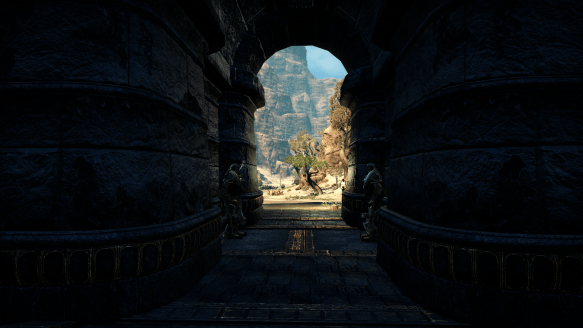
One common misconception I read was that all Dwemer lived in holes in the ground and deep under mountains, and that they would often go weeks, perhaps even months without feeling the warmth of the sun, or brush of the wind upon their skin. But like Volenfell, much of this city is built in and between mountains and hills, with hidden canyons, ravines and gorges linking many of their great halls and workshops. Of course unlike many of the settlements discovered in Morrowind and Skyrim, the Dwemer of Hammerfell had no fear of the elements because metal constructs tend not to rust in the sands.

Screenshot_20200501_195638

S.K

477. A cut above

Screenshot_20200422_215704

At the Qharroa ruins in Southern Bangkorai, the esteemed archaeologist Lady Clarisse Laurent conducts important research into the ancient Yokudan culture. Unfortunately for the brilliant Breton vile goblins have overrun one of her camps and monstrous gargoyles roam the rubble strewn grounds. But the Lady has worse news, her hapless assistant Sibbons has somehow managed to get himself solidified into solid rock during one of the Lady’s ingenious alchemical experiments.

The ever magnanimous Lady however appears to be blaming herself for his utterly inconsiderate condition, this is of course ridiculous and totally unacceptable. It does go to show once more however that there seems to be no limits to this Lady’s compassion. She is truly a cut above and no mistake.

I shall endeavour, under the Lady’s instructions, to return her dimwit to flesh and blood, though I don’t understand why she would want him back when she could have me attend her instead.

S.K

476. The Golden Oasis

Screenshot_20200331_190956

The southern Bangkorai city of Hallin’s Stand glows aureately under the morning Hammerfell sun, or some might say the High Rock sun, for this glorious city has long been betwixt and between. Coveted not only for her beauty, but also the essential position she holds on the trade route between High Rock, Cyrodiil and the lands to the south.

But now all claims between Evermore and Sentinel upon the sandstone city are but nugatory, for a new suitor from the south has intruded under treacherous veil and now occupies her nub. Tharn’s Seventh Legion have taken the city, but the Imperial’s hold upon her is unsteady, for her civilians suffer, especially their purses, and Hallin’s Stand seems but a whisper away from insurrection.

Screenshot_20200404_195058

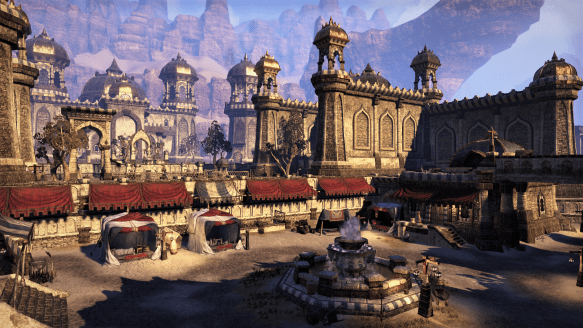
For this city was made golden not only by the sun, nor by the taxes extracted from the caravans that stopped for essential water and rest, but also by it’s famed marketplace. Indeed, the very first thing you see when you arrive through the giant gates from the barren world without, is the huge market square filled with stalls covered in opulent bright cloths.

Before the arrival of the Imperials this was a thriving, bustling market where travellers would stock up before attempting to cross the desert north towards High Rock, or the barren lands east though Craglorn. Stalls selling everything from hard breads, shimmering jewels, shining armour, dried meats, pristine linens, and juicy figs all vied for the travellers coin. It is no wonder the city’s markets earned her the nickname, the Golden Oasis.

Now however only Imperial soldiers and beggars can be found wandering the empty stalls, and as the colours of the bright cloths slowly fades into the desert darkness, the oppressive silence that hangs heavy over the city like a thick blanket is finally broken… by a whisper.

S.K